
The Hadza, or Hadzabe, are an indigenous ethnic group in north-central Tanzania, living around Lake Eyasi in the central Rift Valley and in the neighbouring Serengeti Plateau. The Hadza number just under 1,000 and live as hunter-gatherers, much as their ancestors did for thousands of years. They are among the last hunter-gatherers in the world.
As descendants of Tanzania’s aboriginal hunter-gatherer population, they have probably occupied their current territory for thousands of years, with relatively little modification to their basic way of life until the past hundred years. Since the 18th century, the Hadza came into increasing contact with farming and herding people entering Hadzaland and its vicinity; the interactions were often hostile and caused population decline in the late 19th century. The first European contact and written accounts of the Hadza are from the late 19th century. Since then, there have been many attempts by successive colonial administrations, the independent Tanzanian government, and foreign missionaries to settle the Hadza. These have largely failed, and many Hadza still pursue virtually the same way of life as their ancestors. In recent years, they have been under pressure from neighbouring groups encroaching on their land, and also affected by tourism and safari hunting.
The Hadza are organized into bands, called ‘camps’, of typically 20–30 people, though camps of over a hundred may form during berry season. There is no tribal or other governing hierarchy, and conflict may be resolved by one of the parties voluntarily moving to another camp. The Hadza live in a communal setting and engage in cooperative child rearing, where many individuals (both related and unrelated) provide high quality care for children.
Hadza men usually forage individually, and during the course of the day usually feed themselves while foraging, and also bring home some honey, fruit, or wild game when available. Women forage in larger parties, and usually bring home berries, baobab fruit and tubers, depending on availability. Men and women also forage cooperatively for honey and fruit, and at least one adult male will usually accompany a group of foraging women. During the wet season, the diet is composed mostly of honey, some fruit, tubers, and occasional meat. The contribution of meat to the diet increases in the dry season, when game become concentrated around sources of water. During this time, men often hunt in pairs, and spend entire nights lying in wait by waterholes, hoping to shoot animals that approach for a night-time drink, with bows and arrows treated with poison. The Hadza are highly skilled, selective, and opportunistic foragers, and adjust their diet according to season and circumstance.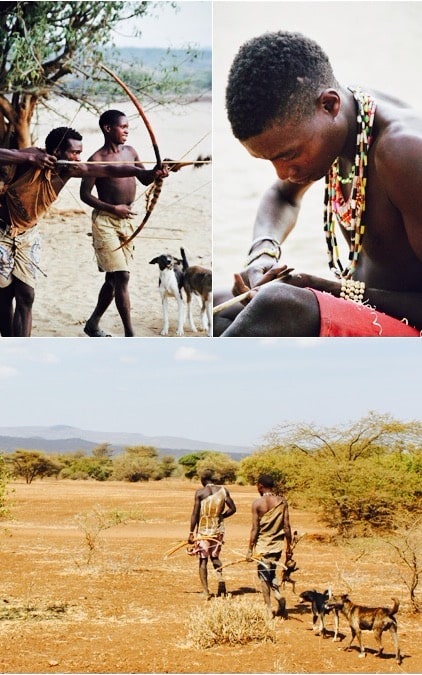
Comments are closed.